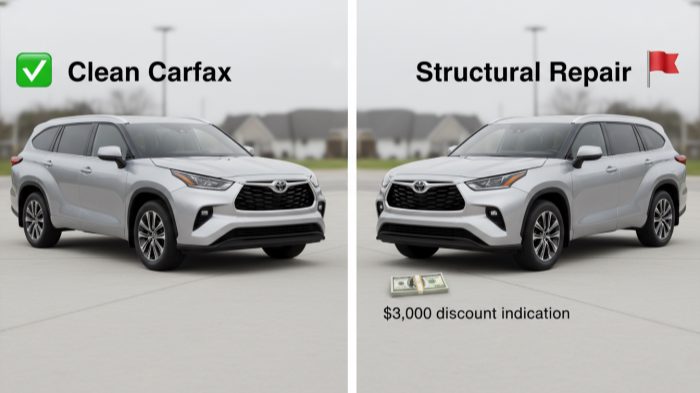
I have a problem that I cannot solve with a tape measure or a camera phone. And I know I am not the only one.
The situation
2022 Toyota Highlander Platinum, 35,000 miles. Rear-ended at a stoplight. Other driver's fault. Their insurance paid for the repair.
The damage looked minor from the outside. Bumper cover cracked. Tailgate scratched. No broken glass. No bent wheels. I thought it was a $3,000 cosmetic job.
Then the shop took the bumper off.
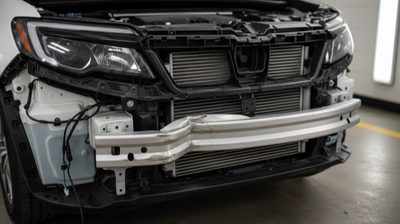
The rear body panel was buckled. Both rear rails were bent at the very ends – about six inches from the bumper mounting points. No kinks. No tears. But bent enough that the shop said "these need to be pulled and reinforced."
The final repair: rear body panel replaced. Both rear rails pulled and sectioned at the factory splice points. New bumper beam. New tailgate. New floor pan section in the spare tire well.
Total bill: $11,400.
The car looks perfect. You cannot tell anything happened. The paint matches. The gaps are even. The tailgate closes with one finger.
But the structural repair is on the Carfax. I checked. It says "structural damage reported" and "rear frame repair."
I am not angry about the repair. The shop did good work. The car drives straight. No noises. No leaks.
But I know what "structural damage" means to a future buyer. And I want to be ready when I sell.
The problem I cannot solve
I have read the diminished value threads here. I know the basics: hire an appraiser, get a report, file a claim, negotiate, maybe get paid.
But those threads assume visible damage or clear measurement issues.
My problem is different.
The car looks perfect. It drives perfect. A regular buyer walking up to this car in a parking lot would never know it was hit. Even a mechanic doing a pre-purchase inspection might miss it if they did not put it on a lift and know exactly where to look.
So how do I document diminished value on a car that hides its scars?
If I hire an appraiser, what are they actually measuring? The car is straight. The paint is shiny. The gaps are even. An appraiser cannot see the section welds without removing interior trim. They cannot see the rail pull without a frame rack.
Is a Carfax printout enough? Or do I need something more?
What I have done so far
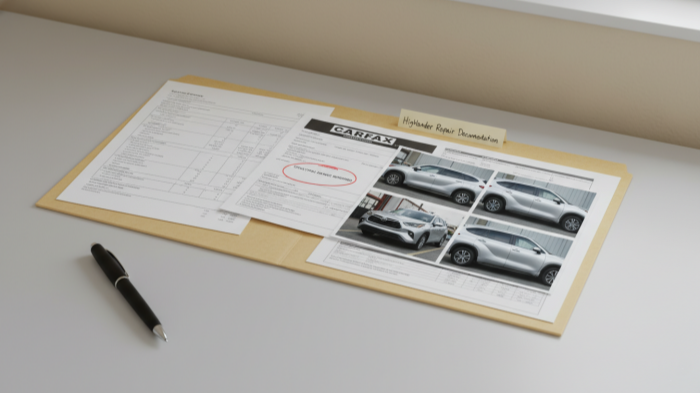
I went back to the shop and asked for documentation. Here is what I got:
Final invoice with all line items (includes "rear rail section – both sides")
Post-repair frame measurement sheet (all green)
Photos of the damage before repair (shows the buckled rear body panel)
Photos during repair (shows the rails cut and welded)
I do not have photos of the bare welds before seam sealer. The shop applied cavity wax and seam sealer before I could inspect. I asked. They said "standard procedure."
I also pulled the Carfax myself. It shows the accident and the structural repair flag.
I also pulled a second Carfax report using a different VIN from a similar Highlander with no accidents. Same year. Same mileage. Same options. That car is listed for private sale at $38,500.
My car? I put it on Facebook Marketplace for one week at $35,000 with full disclosure. I got three messages. One asked "is the frame straight?" I said "repaired but straight." They never replied. The other two did not even ask. They just scrolled past.
I took it down after a week. No serious offers.
What I think the loss is
Based on that one-week experiment, the market seems to discount a structural repair by at least 3,000 to3,000to4,000 on a $38k car. That is about 8-10%.
But that is just one data point. And my listing had terrible photos. And I only left it up for a week. And Facebook Marketplace is not exactly a scientific auction.
I want real data. Not my own sloppy experiment.
What I need from you
1. For those who have successfully claimed diminished value on a structural repair that looks cosmetically perfect: what evidence did you provide? Carfax? Shop invoice? Frame measurements? Photos of the bare welds? Something else?
2. What is the single most effective document to prove that a car with no visible issues actually has a history that reduces its value? Is there a standard form or report that appraisers use for this specific situation?
3. Has anyone here sold a structurally repaired car privately with full disclosure? What percentage of clean retail value did you actually get? Not what an appraiser said. What a buyer paid.
4. For appraisers in the room: how do you calculate diminished value on a car that measures straight and looks perfect? Do you just apply a standard percentage for "structural repair" regardless of quality? Or do you adjust based on repair documentation?
What I am not asking
I do not need "you should have totaled it." That ship sailed. The insurance math did not work.
I do not need "diminished value is hard to prove." I know. That is why I am asking for methods, not encouragement.
I do not need "just keep the car for 10 years." That is an option. But I want to understand my options, not surrender to one.
If you have data
Post your story. Especially if:
You received a diminished value payment after a structural repair with no visible damage (tell me what evidence you used)
You sold a structurally repaired car privately (tell me the percentage loss relative to clean retail)
You are an appraiser who specializes in hidden structural damage (tell me what you actually look for)
You bought a structurally repaired car without knowing it (tell me how you found out and what you paid vs clean retail)
Link any similar case files. I want to read about outcomes, not theories.
Bottom line
I am not trying to punish the insurance company. They paid for the repair. That is what they owed me.
I am trying to quantify what I lost. A car with a clean frame is worth more than a car with a repaired frame. Even if they look identical. Even if they drive identical.
The market knows the difference. I want to know the number. And I want to know how to prove it.
Not because I am greedy. Because I want to be made whole. And I do not think "whole" means a perfect paint job on a bent frame.
Tell me how you have done it. Or tell me why I should stop trying.
No notes yet — write the first.