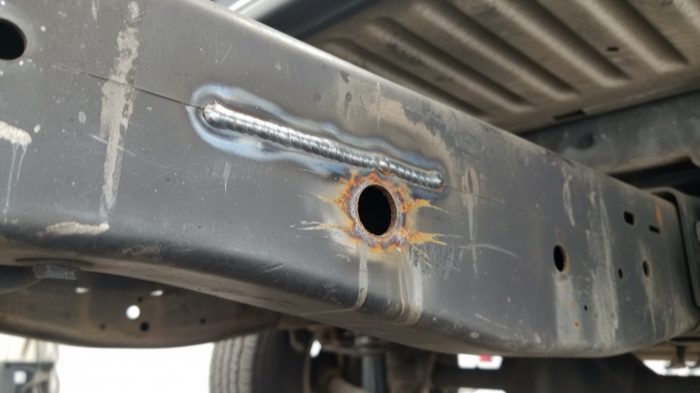
I have been welding structural repairs for eight years. I take pride in my beads. Clean penetration. No spatter. No undercut. My welds pass inspection every time.
But lately I have been losing sleep over something that is not about my welds.
It is about where the boss tells me to cut.
The question I cannot shake
We all know the manufacturer gives a sectioning zone. Sometimes six inches long. Sometimes eight. Sometimes the whole area between two factory seams.
But within that zone, there is good real estate and bad real estate.
And I am starting to think a perfect weld in a bad spot is worse than an okay weld in a good spot.
So here is my question for the other techs and engineers in this room:
How much does a poorly chosen cut point matter if the weld itself is flawless?
Because I have been told my whole career "just follow the zone and weld it right." But I am not sure that is the whole truth anymore.
What I have seen in the shop
I work at a high-volume DRP shop. The estimator tells me where to cut based on part availability and labor hours, not based on structural logic. I am not supposed to question it. I just cut, weld, and move to the next car.
But I have noticed patterns.
Bad cut example one: Late model RAV4, B-pillar section. The estimator had me cut exactly one inch above the seatbelt anchor. Technically within the zone. But that anchor bolt hole is a stress riser. Two months later the car came back with a creak. No weld failure. But the metal around the anchor had deformed slightly. Customer said it felt wrong. I agreed with him.
Bad cut example two: F-150 rear frame section. Cut placed right where the frame rail has a factory hole for a wiring clip. The weld looked beautiful. But six months later, rust bubbles appeared exactly at that hole. Water got in through the hole, got behind the weld, and started eating from inside. The weld itself was fine. The cut point killed it.
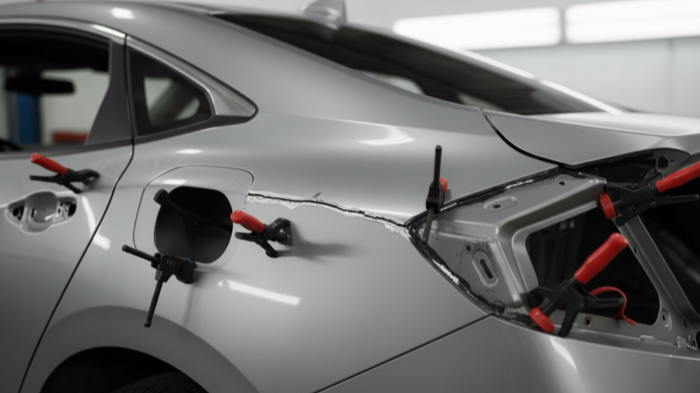
Bad cut example three: Honda Civic quarter panel replacement with inner wheel house section. Cut line ran right through a compound curve instead of a flat section. The weld held. But the panel never sat right. The gas cap door was always 2mm off. No matter how many times we adjusted it. The cut point made the whole job impossible to finish clean.
In all three cases, my welds passed. In all three cases, the repair failed in a way that had nothing to do with my work.
What I think matters more than weld quality
After eight years, here is my personal list of what makes a cut point good or bad. I would love to hear where I am wrong.
Good cut point:
Flat or very gentle curve
At least 3 inches away from any hole, clip mount, or bracket
Accessible for cavity wax on both sides after welding
Allows a backing plate or reinforcement if the joint needs it
Measurable from a fixed reference point (not "eyeball it")
Bad cut point:
On a sharp curve or body line
Within 2 inches of a seatbelt anchor, suspension mount, or hinge
Somewhere you cannot reach to clean, prep, or coat after welding
Chosen because "that is where the replacement panel ends"
Chosen because it saves 0.3 labor hours
The worst one is the last one. And I see it every week.
What I want to hear from others
I am posting this because I need to know if I am overthinking or if this is a real problem the industry is ignoring.
Answer these:
1. Have you ever seen a structurally sound weld fail because of where it was placed? Not the weld itself failing. The metal around it failing. What happened?
2. How do you push back when an estimator or insurer tells you to cut at a location you know is bad but technically allowed?
3. Do you take photos of the cut location before welding? Do you document why you chose that spot? Or do you just trust the zone?
4. If you could write one rule about cut point selection that is not in the OEM manuals, what would it be?
What I am not asking
I am not asking about weld quality. Assume the weld is perfect.
I am not asking about following OEM procedures. Assume the cut is within the approved zone.
I am asking about the difference between "allowed" and "good." And whether that difference actually matters when the car is back on the road.
A request for the engineers in the room
If there are any structural engineers or former OEM crash test people reading this:
Can you tell me what happens at a cut point during a second impact? Does the stress concentrate at the edge of the weld? At the nearest hole? At the transition from factory steel to repair steel?
I have read the I-CAR papers. They talk about weld strength and corrosion protection. They do not talk about cut point placement relative to load paths.
If you have data, I want to see it.
If you do not have data, say that. Because I am starting to think no one actually studied this.
No notes yet — write the first.